
Orange County Court Dockets are official records that list every case scheduled for hearing in the county’s judicial system. These dockets include civil, criminal, family, probate, and small claims cases handled by the Superior Court of California, Orange County. Each entry provides key details such as case number, party names, hearing type, date, time, and courtroom location. Dockets are updated daily and reflect the current status of all active and recently resolved cases. They serve as the public record of court proceedings and are maintained by the Orange County Clerk-Recorder and the Superior Court’s Case Management System.
These dockets are essential for attorneys, litigants, journalists, researchers, and the general public to track legal actions, monitor case progress, and prepare for hearings. Unlike final judgments or case files, dockets do not contain full legal arguments or evidence but offer a chronological snapshot of scheduled events. Access is governed by California Rules of Court and state public access laws, ensuring transparency while protecting sensitive information. Most docket data is available online through the court’s official portal, allowing instant lookup by case number, party name, or date range. This digital access supports efficient case tracking without requiring in-person visits.
What Are Orange County Court Dockets?
Orange County Court Dockets are structured logs of all judicial proceedings within the county’s court system. They are generated and maintained by the Orange County Superior Court and serve as the authoritative source for scheduled hearings, motions, trials, and other legal events. Each docket entry corresponds to a specific case and includes critical identifiers and procedural details. These records are public under California law, with limited exceptions for sealed or confidential matters such as juvenile cases or domestic violence restraining orders.
Types of Cases Included in the Docket
The Orange County docket system covers a wide range of legal matters. Each category has its own docket schedule and is managed by specialized divisions within the court.
- Civil Dockets: Include contract disputes, personal injury claims, landlord-tenant issues, and business litigation. These cases are typically assigned to the Civil Division and scheduled in courthouses like the Central Justice Center in Santa Ana.
- Criminal Dockets: List arraignments, pretrial hearings, motions, and trials for misdemeanor and felony offenses. These are handled by the Criminal Division and often appear in the Harbor Justice Center or North Justice Center.
- Family Court Dockets: Cover divorce, child custody, support, adoption, and domestic violence cases. These are managed by the Family Law Division and frequently scheduled in the Lamoreaux Justice Center.
- Probate Dockets: Include estate administration, guardianship, conservatorship, and trust matters. These are heard in the Probate Division, usually at the Central Justice Center.
- Small Claims Dockets: Handle disputes under $10,000. Hearings are informal and scheduled at various locations, including the Harbor and North Justice Centers.
Structure of a Docket Entry
Each docket entry follows a standardized format to ensure consistency and usability. The structure allows users to quickly identify key details about a case.
| Field | Description |
| Case Number | A unique identifier assigned when the case is filed (e.g., 30-2024-00123456). |
| Case Title | Names of the parties involved (e.g., Smith v. Jones). |
| Case Type | Classification such as Civil, Criminal, Family, or Probate. |
| Hearing Date | The scheduled date for the next court event. |
| Hearing Time | Exact time the hearing is set to begin (e.g., 8:30 AM). |
| Hearing Type | Type of proceeding (e.g., Arraignment, Motion to Dismiss, Trial). |
| Courtroom | Room number and location (e.g., Dept. C-12, Central Justice Center). |
| Judge | Name of the presiding judicial officer. |
| Status | Current case status (e.g., Active, Closed, Continued). |
Legal Authority and Public Access
Orange County Court Dockets are governed by the California Rules of Court, Rule 2.501, which mandates public access to court records. The dockets are considered judicial records and are presumptively open to the public unless sealed by court order. Exceptions include cases involving minors, sealed settlements, or protected personal information under the California Constitution and Penal Code Section 853.9. The court must balance transparency with privacy, especially in sensitive matters like domestic violence or mental health proceedings.
Access is facilitated through the Orange County Superior Court’s online portal, which complies with the California Judicial Council’s standards for electronic access. The system logs user activity for security and auditing purposes. Users are prohibited from using docket data for unlawful purposes such as harassment or discrimination. Misuse may result in account suspension or legal action under California Civil Code Section 1798.29.
How to Search Orange County Court Dockets Online
The Orange County Superior Court provides a free, web-based tool for searching court dockets. This system allows users to retrieve real-time information on civil, criminal, family, and probate cases. The search function is hosted on the official court website and does not require payment or registration for basic queries. However, advanced features like name-based searches may require a free account. The tool is updated multiple times daily to reflect new filings, continuances, and case resolutions.
Official Online Docket Search Portal
The primary platform for accessing Orange County Court Dockets is the Online Case Access system managed by the Orange County Superior Court. This portal is the only official source for verified docket information and is maintained by the court’s IT division. It integrates with the court’s Case Management System (CMS) to deliver accurate, up-to-date records. The system supports searches by case number, party name, attorney, or date range. All data is encrypted during transmission to protect user privacy.
To begin, go to the official URL: http://www.occourts.org/online-services/case-access/. This page hosts the search interface and provides instructions for first-time users. The site is compatible with all major browsers and mobile devices. For optimal performance, use Chrome, Firefox, or Safari with JavaScript enabled. The portal is available 24/7, with scheduled maintenance typically occurring on Sundays between 2:00 AM and 4:00 AM Pacific Time.
Steps Search Instructions
Follow these exact steps to perform a successful docket search. Each field must be completed correctly to retrieve results.
- Open your web browser and navigate to http://www.occourts.org/online-services/case-access/.
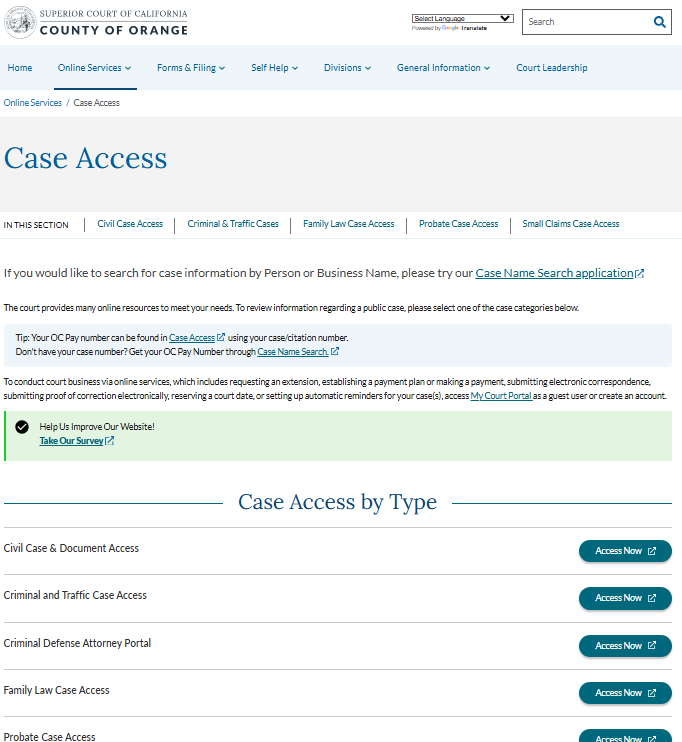
- On the homepage, locate the search form labeled “Case Search”.
- Choose your search method:
- To search by case number: Enter the full case number (e.g., 30-2024-00123456) in the “Case Number” field.
- To search by party name: Click the “Name Search” tab, then enter the last name and first name in the respective boxes. Use the format “Smith, John” for best results.
- To search by date: Select the “Date Search” option and enter a start and end date using the MM/DD/YYYY format.
- Click the “Search” button located below the form.
- The system will process your request and display a list of matching cases.
After clicking “Search,” the results page will show a table with the following columns: Case Number, Case Title, Case Type, Filing Date, and Next Hearing Date. Click on any case number to view the full docket history, including all past and future hearings, motions, and court orders. The detailed view includes the judge’s name, courtroom, and hearing type for each event.
The Search Results
The search results provide specific data points that help users track case activity. Each entry in the results table contains verified information pulled directly from the court’s database.
- Case Number: A 16-digit identifier used to reference the case in all court documents.
- Case Title: The official names of the parties (e.g., People v. Garcia or Johnson v. Lee).
- Case Type: Indicates whether the case is Civil, Criminal, Family, Probate, or Small Claims.
- Filing Date: The date the case was officially opened in the system.
- Next Hearing Date: The scheduled date for the upcoming court event.
When you click on a case number, the system displays the full docket sheet. This includes a chronological list of all hearings, filings, and rulings. Each entry shows the date, time, courtroom, judge, and nature of the proceeding. For example, a criminal case might show “Arraignment – 03/15/2024, 8:30 AM, Dept. C-10, Judge Martinez.” This level of detail allows users to monitor case progress and prepare for appearances.
Searching by Case Number, Name, or Date
Orange County Court Dockets can be searched using three primary methods: case number, party name, or date range. Each method serves a different purpose and yields specific types of results. The case number search is the most precise, while name and date searches are broader and may return multiple matches. Users should choose the method that best fits their needs.
Searching by Case Number
The case number is the most reliable way to locate a specific docket. Each case in Orange County is assigned a unique 16-digit number at filing. This number follows the format: [Court Code]-[Year]-[Sequential Number] (e.g., 30-2024-00123456). The first two digits (30) represent the Orange County Superior Court. The next four digits indicate the year of filing, and the final eight digits are the sequential case number.
To search by case number:
- Go to http://www.occourts.org/online-services/case-access/.
- Select the “Case Number” search tab.
- Type the full case number into the input field. Do not include spaces or dashes.
- Click “Search”.
The system will return a single result with the complete docket history. This includes all scheduled hearings, past rulings, and case status. For example, entering “30-2024-00123456” might show a civil case with a motion hearing set for April 5, 2024, in Department C-15. The result will also list the attorneys of record and any related case numbers.
Searching by Party Name
Name-based searches are useful when the case number is unknown. However, they may return multiple results if the name is common. The system uses a partial match algorithm, so entering “Smith” will return all cases where “Smith” appears in the party name field.
To search by name:
- Navigate to the “Name Search” tab on the case access page.
- Enter the last name in the first field and the first name in the second field.
- Use the format “Last Name, First Name” for accuracy (e.g., “Garcia, Maria”).
- Click “Search”.
The results will display all cases involving that name. Each entry shows the case number, title, type, and next hearing. Clicking a case number opens the full docket. Note that name searches are case-insensitive but must match the spelling in the court record. Nicknames or aliases may not appear unless formally listed.
Searching by Date Range
Date searches help users find all cases with hearings on a specific day or within a period. This is useful for attorneys scheduling appearances or researchers studying case volume.
To search by date:
- Select the “Date Search” option.
- Enter a start date and end date in MM/DD/YYYY format.
- Choose the type of date to search: Filing Date, Hearing Date, or Both.
- Click “Search”.
The system returns a list of cases with events in that range. For example, searching from 03/01/2024 to 03/31/2024 for hearing dates might show 1,200 entries. Results can be sorted by case number, date, or type. This method does not require a case number or name but may produce large result sets.
Types of Cases in the Docket System
The Orange County Court Docket system categorizes cases into five main types: civil, criminal, family, probate, and small claims. Each type follows distinct procedural rules and is managed by a dedicated division within the Superior Court. Understanding these categories helps users interpret docket entries and locate relevant cases.
Civil Dockets
Civil dockets include lawsuits between individuals or entities over legal rights and obligations. These cases typically involve monetary damages, injunctions, or declaratory judgments. Common examples are breach of contract, personal injury, property disputes, and business litigation. Civil cases are assigned to the Civil Division and heard at the Central Justice Center in Santa Ana or the North Justice Center in Fullerton.
- Filing Process: Begins with the plaintiff filing a complaint and paying a filing fee.
- Case Number Format: Starts with “30-” followed by the year and sequence (e.g., 30-2024-00123456).
- Hearing Types: Include case management conferences, motions, mediations, and trials.
- Typical Duration: Most civil cases resolve within 12 to 24 months.
Civil dockets are updated daily with new filings and hearing schedules. Users can track case progress by monitoring the “Next Hearing Date” field. For example, a docket might show “Motion for Summary Judgment – 05/10/2024, 9:00 AM, Dept. C-20.” This indicates a key procedural event that could determine the outcome of the case.
Criminal Dockets
Criminal dockets list all misdemeanor and felony prosecutions in Orange County. These cases are brought by the District Attorney’s Office against individuals accused of violating state laws. The docket includes arraignments, pretrial conferences, evidentiary hearings, and trials. Criminal cases are managed by the Criminal Division and heard at the Harbor Justice Center, North Justice Center, or Lamoreaux Justice Center.
- Case Initiation: Begins with an arrest or citation, followed by the filing of a complaint or indictment.
- Charging Document: Specifies the alleged offenses using California Penal Code sections.
- Bail and Bond: Listed in the docket if set by the court.
- Sealed Records: Some criminal dockets are restricted if the case involves a minor or is under investigation.
Each criminal docket entry shows the defendant’s name, charges, next court date, and bail amount. For example, a docket might read: “People v. Lee – Charge: PC 459 (Burglary) – Arraignment: 04/02/2024, 8:30 AM, Dept. H-5 – Bail: $50,000.” This information helps defendants, attorneys, and victims prepare for court appearances.
Family Court Dockets
Family court dockets cover domestic relations matters such as divorce, child custody, spousal support, and domestic violence restraining orders. These cases are highly sensitive and often involve confidential information. The Family Law Division schedules hearings at the Lamoreaux Justice Center in Orange.
- Case Types: Dissolution of marriage, legal separation, paternity, adoption, and guardianship.
- Hearing Types: Temporary restraining orders, custody evaluations, settlement conferences, and trials.
- Confidentiality: Some records are sealed to protect children or victims of abuse.
- Mediation Requirement: Most custody cases require mediation before trial.
Family dockets show the parties’ names, case type, and next hearing. For example: “Smith v. Smith – Dissolution – Custody Hearing: 04/15/2024, 1:30 PM, Dept. F-8.” The docket does not disclose financial details or personal allegations, which are kept in sealed files.
Accessing Dockets for Specific Case Types
Each case type in the Orange County docket system has unique access rules and procedural requirements. While all dockets are publicly available in principle, certain restrictions apply based on the nature of the case. Users must understand these distinctions to retrieve accurate information and comply with court policies.
Civil Case Dockets
Civil case dockets are fully accessible online and in person. No special permission is required to view or copy these records. The online system provides real-time updates on filings, motions, and hearings. Users can search by case number, party name, or attorney. For example, searching for “Johnson v. ABC Corp” will return all related civil litigation.
Key data points in civil dockets include:
- Complaint filing date
- Defendant’s response deadline
- Case management conference dates
- Discovery cut-off dates
- Trial confirmation hearings
These entries help parties track deadlines and prepare for court events. The docket also lists the assigned judge and courtroom, which is essential for appearing on time.
Criminal Case Dockets
Criminal dockets are public but may have limited details for active investigations or juvenile cases. Adult criminal records are accessible online, while juvenile records are sealed by law. The docket shows the defendant’s name, charges, bail amount, and next court date. However, it does not include police reports or witness statements.
For example, a criminal docket might display:
- Case Number: 30-2024-00987654
- Defendant: Martinez, Carlos
- Charge: PC 211 (Robbery)
- Arraignment: 03/20/2024, 8:30 AM, Dept. H-3
- Bail: $100,000
This information is sufficient for tracking the case, but does not reveal the evidence or plea status. Users must submit a formal records request to request additional documents.
Family and Probate Dockets
Family and probate dockets are subject to greater privacy protections. While the basic schedule is public, detailed filings may be restricted. For example, financial affidavits in divorce cases or medical records in guardianship proceedings are not available online. Users can view the hearing date and judge, but must visit the courthouse to access sealed documents.
Probate dockets list estate filings, creditor claims, and distribution hearings. Each entry includes the decedent’s name, case number, and next court date. For example: “Estate of Brown, John – Petition for Probate – Hearing: 04/10/2024, 9:00 AM, Dept. P-2.” These records help heirs and creditors monitor estate administration.
Offline Access to Court Dockets
While online access is the most efficient method, Orange County also provides offline options for retrieving court dockets. These include in-person visits, phone inquiries, and mailed requests. Offline methods are useful for users without internet access or for obtaining certified copies of records.
Visiting the Courthouse
The Orange County Superior Court operates multiple courthouses where the public can view dockets. Each location has a public access terminal connected to the court’s database. Staff are available to assist with searches, but cannot provide legal advice.
- Central Justice Center: 700 Civic Center Dr W, Santa Ana, CA 92702. Handles civil, criminal, and probate cases.
- Harbor Justice Center: 23141 Moulton Parkway, Laguna Hills, CA 92653. Focuses on criminal and traffic cases.
- North Justice Center: 1275 N. Berkeley Ave, Fullerton, CA 92832. Manages civil and family cases.
- Lamoreaux Justice Center: 341 The City Dr S, Orange, CA 92868. Specializes in family law.
To use the public terminals, visit the clerk’s office during business hours. Search by case number or name using the on-screen interface. Printed copies of dockets can be obtained for a fee of $0.50 per page. Certified copies require additional processing and cost $25 per document.
Phone and Mail Requests
The court accepts phone and mail inquiries for docket information. However, responses may take several days. For phone requests, call the main clerk’s office at (657) 622-6767. Provide the case number or party names. Staff will verbally confirm the next hearing date and courtroom.
For mailed requests, send a letter to:
- Orange County Clerk of Court
- PO Box 238
- Santa Ana, CA 92702-0238
Include the case number, your name, address, and a self-addressed stamped envelope. Processing takes 7 to 10 business days. There is no fee for basic docket information.
Public Access Terminals
Each courthouse has self-service terminals for docket searches. These machines are free to use and operate 24/7 in some locations. Users can search by case number, name, or date. Results can be printed or emailed. The terminals are located in the clerk’s office lobby and are wheelchair accessible. For example, at the Central Justice Center, the terminal is near the main entrance. Follow the on-screen prompts to enter search criteria. The system displays the same data as the online portal, including hearing dates and courtroom assignments.
The Docket Status and Hearing Types
Court dockets include status indicators and hearing types that reflect the current stage of a case. These labels help users understand whether a case is active, closed, or pending further action. Each hearing type serves a specific function in the legal process.
Common Docket Status Codes
The docket system uses standardized status codes to indicate the progress of a case. These codes appear next to the case number or in the status column.
| Status | Meaning |
| Active | The case is ongoing and has future hearings scheduled. |
| Closed | The case has been resolved and no further action is expected. |
| Continued | A hearing has been postponed to a later date. |
| Vacated | A hearing was canceled and may be rescheduled. |
| Transferred | The case has been moved to another court or department. |
For example, a docket showing “Status: Continued” means the next hearing was postponed. Users should check the new date to avoid missing court.
Types of Hearings Listed in Dockets
Each hearing type corresponds to a specific stage in the legal process. The docket specifies the nature of the event and its purpose.
- Arraignment: The defendant enters a plea (guilty, not guilty, or no contest).
- Case Management Conference: The judge sets deadlines for discovery and trial.
- Motion Hearing: A party requests a ruling on a legal issue (e.g., dismissal).
- Trial: Evidence is presented, and a verdict is reached.
- Sentencing: The judge imposes a penalty after a conviction.
- Restraining Order Hearing: A judge decides whether to issue or extend a protective order.
For example, a docket might list “Motion to Suppress Evidence – 04/05/2024, 9:00 AM, Dept. C-10.” This indicates a critical pretrial hearing that could affect the outcome of a criminal case.
How to Interpret Hearing Schedules
Hearing schedules are listed in chronological order. The most recent event appears at the top, followed by future dates. Users should note the time, courtroom, and judge for each entry. Missing a hearing can result in a default judgment or an arrest warrant.
For example:
- 03/10/2024 – Arraignment – 8:30 AM – Dept. H-5 – Judge Lee
- 03/25/2024 – Pretrial Conference – 1:00 PM – Dept. H-5 – Judge Lee
- 04/12/2024 – Trial – 9:00 AM – Dept. H-5 – Judge Lee
This shows a criminal case progressing toward trial. Each hearing builds on the previous one.
| Address | 700 Civic Center Dr W, Santa Ana, CA 92702 |
| Phone | (657) 622-6767 |
| Hours | Monday–Friday: 8:00 AM – 4:00 PM |
(FAQs) About Orange County Court Dockets
Orange County court dockets help the public track hearings, motions, filings, and case updates through the county’s official court system. These records are commonly used by attorneys, defendants, plaintiffs, researchers, and family members who need current case information. Most docket searches can be completed online using a case number or party name. While many records are publicly accessible, California privacy laws restrict access to sealed, juvenile, and confidential court information.
Can I access Orange County court dockets for free, and are there any restrictions on use?
Yes, Orange County court dockets are free to access through the official online portal. There is no charge for viewing or searching dockets. However, printed or certified copies cost $0.50 per page and $25 per certification. The dockets are public records under California law, but some information may be redacted to protect privacy, such as Social Security numbers or juvenile records. Users are prohibited from using docket data for harassment, stalking, or commercial solicitation. The court logs all searches for security purposes. Misuse may result in account suspension or legal penalties under California Civil Code Section 1798.29. The system is available 24/7, with maintenance windows on Sundays from 2:00 AM to 4:00 AM.
What information is included in a typical Orange County court docket entry?
A standard docket entry contains the case number, case title, case type, hearing date, hearing time, hearing type, courtroom, judge, and status. For example, a criminal docket might show: “Case Number: 30-2024-00987654, Defendant: Garcia, Maria, Charge: PC 487 (Grand Theft), Hearing: Arraignment, Date: 04/01/2024, Time: 8:30 AM, Courtroom: Dept. H-3, Judge: Smith, Status: Active.” This provides all essential details for tracking the case. The full docket history includes past hearings, motions, and rulings in chronological order. Each entry is timestamped and linked to the presiding judge. The system does not include evidence, witness lists, or sealed documents, which require a formal records request.
How often are Orange County court dockets updated, and how current is the information?
Orange County court dockets are updated multiple times daily, typically by 6:00 AM, 12:00 PM, and 6:00 PM Pacific Time. New filings, continuances, and rulings are entered into the system within 24 hours of occurrence. The online portal reflects the most recent data, ensuring users have access to current information. For example, if a hearing is continued on a Monday morning, the new date will appear in the docket by Tuesday. The system is synchronized with the court’s Case Management System (CMS), which processes all official records. Users can trust the online docket for scheduling and case tracking. However, last-minute changes may not appear immediately, so it is advisable to confirm hearing details the day before court.
Are family court and probate dockets available online, and what limitations apply?
Yes, family court and probate dockets are available online through the same portal as civil and criminal cases. Users can search by case number or party name. However, detailed filings such as financial affidavits, medical records, or child custody evaluations are often sealed to protect privacy. The public docket shows only the hearing schedule, case type, and judge. For example, a divorce case might list “Custody Hearing – 04/10/2024, 9:00 AM, Dept. F-5,” but the supporting documents are not accessible online. To view sealed records, individuals must visit the courthouse and submit a written request. Some probate records, such as wills, become public after the estate is opened, but beneficiary details may be restricted.
What should I do if I cannot find a case in the docket search, even with the correct case number?
If a case does not appear in the search results, verify that the case number is entered correctly without spaces or dashes. Ensure you are using the official portal at http://www.occourts.org/online-services/case-access/. If the issue persists, the case may be under seal, recently filed, or assigned to a different court. Contact the clerk’s office at (657) 622-6767 for assistance. Provide the case number, party names, and filing date. Staff can confirm whether the case is active and provide the correct docket information. In rare cases, technical errors may delay updates, but these are resolved within 24 hours.